Studying abroad – what you need to consider

Darllenwch yn y Gymraeg

Studying abroad, whether it is a full three- or four-year course or for a year as part of a UK-based degree, can be an incredible and potentially life-changing opportunity.

seren blog.jpeg

As well as all the traditional benefits of attending university, such as furthering your academic career, meeting new people and generally expanding your horizons, studying abroad also offers the chance to experience a completely different way of learning and an entirely new culture at the same time.

However, while there are many sources of information available (see below) and plenty of people to turn to for help and advice, studying abroad comes with an extra set of considerations, some of which are not immediately obvious.

Studying abroad takes a huge amount of planning and preparation, much of which you must do yourself.

Here are some of the things you need to consider:

Documentation

  • Passports To travel abroad you will need a passport at the very least, even if you plan to study within the European Union.You will also need to make sure your passport is not due to expire while you are abroad, and some countries will insist on a minimum period of time left on your passport (often around six months) for you to travel.
  • Visas You may also need extra documentation or accreditation to travel to certain countries, such as a Visa or an online electronic travel authorisation. You should check with the national website of the country to which you plan to travel for the most up-to-date information.

UCAS has some general visa and immigration information here.

Insurance and health

  • Insurance No matter how long you plan to travel abroad for, insurance is essential. Luckily there are many different student insurance options available, so make sure to shop around for a good deal. However, this does not mean you should compromise – always pay for the most comprehensive cover you can get, because you can never be sure when you will need it.
  • Health Some countries will require you to have vaccinations before you travel, while others will have their own specific medical or healthcare requirements. Again, you should check with the country’s national website for the latest information.

Money 

  • Tuition fees Student life can be expensive at the best of times but studying abroad can prove particularly costly. If you are studying a full course abroad you will have to consider the cost of tuition fees, which can be very high for international students in certain countries. There are various scholarships and bursaries available that can help reduce the cost depending on the country, the institution and the course of study.
  • Cost of living This can vary considerably depending on the country. Some countries will require you to prove you have enough money to meet your living costs as part of your visa application, so diligent financial planning and detailed budgeting is essential.
  • Working You might be able to find employment to supplement your income but again this varies depending on the country, with some restricting the number of hours student visa holders can work and others banning it altogether.

More information and resources

Make sure to keep an eye out for our studying abroad blog series for more helpful advice, testimonials and top tips on studying overseas.

You can also find out more about funding for studying abroad and travel grant information on the Student Finance Wales website in addition to advice from UCAS.
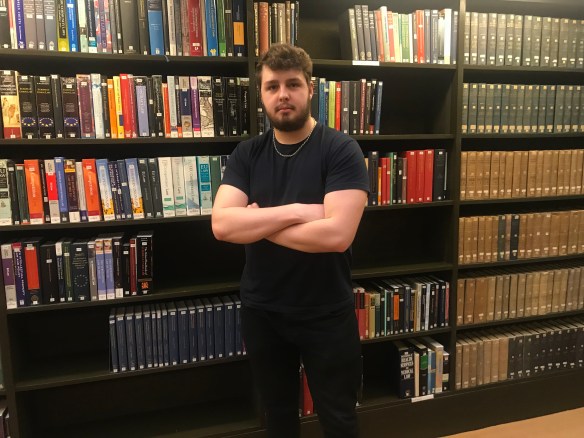
“I can’t thank the Seren Network enough for providing such opportunities to me” Former Seren student who is now studying at Cambridge

Image

Elliott Manwaring

As the Seren Network enters its third year, we’ve been able to catch up with some of the Network’s talented former students to help answer some of your own burning questions about studying at university.

This week, we speak to former Seren student Elliott Manwaring, a medicine student at Cambridge.

Tell us a little about yourself

I’m 18 and originally from Pembrokeshire. I went to Ysgol-y-Preseli and was part of the Pembrokeshire and Carmarthenshire Seren hub.

What are you doing at university?

I’m now in my second term at University of Cambridge, in Peterhouse College, where I’m studying medicine.

I applied to study medicine at Cambridge because of the scientific emphasis placed on the course. I felt that it would set me up to make a much better doctor if I had a strong grounding in the basic medical sciences.

Applying to Cambridge was the best choice I’ve ever made. The campus is such an amazing environment to be in, and the tutors really help encourage me to learn more about my subject.

I would definitely recommend applying to a university where you enjoy the atmosphere and environment.

Having other people around you who are just as keen to learn is really inspiring.

How did Seren help you in your journey to university?

Seren hosted a university access day in Carmarthen where I was able to speak to several universities about applying to study medicine, asking them what the course entailed. It was really helpful in terms of understanding the application process and the structure of each course.

I spoke to an admissions tutor from Cambridge University who motivated me to look further into their course. He urged me to apply after seeing I was passionate about studying on a traditional medical course and explained that it was something that was genuinely achievable, as long as I worked hard enough for it.

That was the day that I really set my heart on studying at Cambridge.

I can’t thank the Seren Network enough for providing such opportunities to me, without it, I doubt I would have applied and I would never be where I am today.

What’s your advice for current students applying for university?

A-levels are a lot of work and everyone finds them tough. Doing small, manageable study sessions is the best way to get things done.

My other main piece of advice would be to make sure that you’re really passionate about the subject you’re applying for.

To get into a top university, admissions tutors want to see that you genuinely love your subject. Allow some time every week to have a read around your subject, to get a feel for what is outside of your A-level syllabus.

Once you’ve found the subject you love, use it as motivation to work hard to get to where you want to go.

I’d never have believed I’d be where I am today, but because of my motivation to get to that end goal. I’m here, and you could be too!

What are your goals for the future?

In the short term, I’m hoping to complete my pre-clinical training in medical school and take an intercalated degree in physiology in my third year. I hope to take part in some medical research projects over the summer and get involved with some medical aid work in third world countries.

In the long term, I hope to finish my training in medical school and work towards becoming a consultant surgeon, while having a role as a fellow at a university to help teach medical students in the future.

Welsh Government announces £3 million of funding for Wales’ brightest pupils

Darllenwch yn y Gymraeg

You may have seen in the news this week an announcement about additional funds from the Welsh Government to support the brightest and most talented students in Wales.

Here’s what it means…

Funding worth £3million will benefit More Able and Talented (MAT) learners in Wales, and will enable the extension of the Seren Network to benefit younger pupils.

Over the next two years, the Welsh Government aims to:

  • Better identify and support schools at regional and national levels
  • Increase opportunities to inspire the highest levels of achievement
  • Develop evidence to support further investment

What will this mean for the Seren Network?

This new plan will also include the extension of the Seren Network so that it reaches younger pupils. From September, Seren will also target talented students before their GCSEs, connecting pupils from different schools and communities and building on our existing links with leading global universities.

key_kirsty-williams

Cabinet Secretary for Education, Kirsty Williams said:

“Further encouraging a culture that supports high aspirations for all learners, teachers and schools is crucial to the delivery of our national mission for education.

“It is clear from PISA, previous Estyn reports, Sutton Trust and UCL research that Wales must do more to identify, support and stretch our more able learners.

“The investment I’m announcing means that we will be able to reach these learners at a much earlier stage, ensuring they have the support and opportunities to reach their full potential.

“The Seren Network already makes a hugely positive contribution to raising aspirations, boosting confidence and encouraging post-16 students to be ambitious.

Expanding the programme will help us to build that confidence in our younger leaners and show them that there are opportunities they may not yet be aware of.

“We have to look at this as a long-term investment; this is about how we create the next generation of entrepreneurs, teachers, scientists and public servants that will drive Wales’s future prosperity and success.

“Getting it right for these learners, and those with the potential to be these learners, therefore means getting it right for everyone.”

Stay tuned on the blog for further information about how this announcement will impact Seren.

You can also keep in touch via our Facebook and Twitter pages.

Welsh Government Student Finance Campaign

Video

The Welsh Government has announced a new student finance package for students starting a first-time undergraduate course in 2018/19. It means you could be eligible for up to £11,250 per year through grants and loans, to help with your living costs.


Why has the Welsh Government offered this support?

The Welsh Government believes money shouldn’t be a barrier to going to university and that it should be an option for everyone, regardless of their household income. The new policy is designed to enable students to focus on their studies and spend less time worrying about making ends meet. By supporting living costs, it means students don’t have to work long hours to earn money alongside their studies to cover living expenses, freeing up time to concentrate on their studies.

Who is eligible?

All eligible first-time undergraduates who are starting a part or full-time course and are from Wales can apply, no matter where they plan to study in the UK.

How much can students get?

  • Those studying full-time as an undergraduate could be eligible for up to £11,250 a year, through a mixture of grants and loans towards living costs, if they live away from home and study in London, and up to £9,000 per year if they live away from home and study anywhere in the rest of the UK.
  • Those studying a full-time undergraduate course and living at home could be eligible for up to £7,650 a year.
  • Grants will be means-tested to support those who need them most – those from a lower income household will receive the highest grant.
  • Students can also take out a maintenance loan to top up what they get. The maximum loan amount will depend on how much grant they receive.
  • Students can also get up to £1,500 towards reducing their maintenance loan when they make the first loan repayment under the Welsh Government partial cancellation scheme.

What about tuition fees?

  • Students can apply for a separate loan to cover tuition fees. In Wales, tuition fees have been capped at £9,000 per year but in other parts of the UK they could be up to £9,250 per year for a full-time undergraduate course.
  • Student Finance Wales provides a loan to cover tuition fees, which will have to be repaid once the student starts earning over £25,000. Loans to cover tuition fees are not means-tested.

How to apply:

Applying for student finance is done directly through the Student Finance Wales website. Full-time students can apply for this support from early spring.

Where can I find out more?

For more details on student finance including information on repayments and extra support, visit: http://www.studentfinancewales.co.uk/

Also, follow Student Finance Wales on:

Twitter: @wg_education

Facebook: www.facebook.com/educationwales


Lowri Morgan: Applying to university

Image

So, you’re beginning your big year of decision making. And so many decisions to make!

I was in your position three years ago; I lived with my extended family in a village in the South Wales valleys and was studying Sociology, English Literature, Drama Studies and the Welsh Baccalaureate at A Level; all through the medium of Welsh. Today I am in my final year of studying for a BSc. Degree in Sociology at the University of Bath.

The last three years have gone so quickly but I remember how stressful it was at the time when deciding what to study and where. For me, I found it useful as a starting point to follow the advice and guidance out there. I knew I wanted to study a subject which I enjoyed even though I wasn’t sure what type of work I wanted to do. I was also unsure of studying in English because my whole education had been through the medium of Welsh.

Draw up a shortlist

Having decided on Sociology, I drew up a (very long!) shortlist based on the usual factors such as rankings, student satisfaction, living costs etc. It wasn’t practical to visit each place on my shortlist so I started visiting the university websites. The two things which helped most were reading the departmental pages and the student feedback about the course and university life. Both these things helped narrow down my choices. Attending the open days was then key to making my final decision. Meeting lecturers and speaking to students on the same course gave me a real feel for the University, it’s hard to explain but I genuinely felt like I would be happy living there! Being happy living at Bath has definitely helped me make the most of my time here.

Remember to showcase your extra-curricular!

Having made my decision I then knew what was needed to achieve my goal, which helped me focus on my studies and helped with writing my personal statement. I was keen to use the personal statement to show that I had gained transferable skills from my activities outside of school which would help with my attitude and approach to university study. I now realise that those extra -curricular skills have played a big part in helping me adapt to life at university. Honestly, when my results came through and Bath offered me a place – I panicked! How would I manage living and studying in England!? What was I thinking?

My panic, however, was short-lived in the whirlwind of preparation for the move and as it turns out, unfounded! Yes, I was nervous, but so was everyone else! I would highly recommend engaging with the university from day one – they do so much to prepare you and ensure that you have the necessary information and support to make the transition go smoothly. Make the most of Freshers week, join any clubs/societies which interest you and enjoy!

Top tip for degree prep: If like me, you plan on applying to an English university, and have chosen to carry on studying a subject you’ve previously studied through the medium of Welsh, start to read around the subject in English too – there is nothing more frustrating than knowing you understand a topic, but having to explain it using terminology in a different language!

Make the most of all the opportunities and support that are out there for you. Enjoy, and best of luck!

Lowri Morgan

Screen Shot 2017-11-29 at 13.33.24 (002)


Open days: top tips from Seren student, Miles Hermann

Image

This week, Miles Hermann from the Ceredigion hub, shares his experiences of open days.

In the process of looking to study at university, it’s essential that applicants visit a range of universities, to get a feel for the course and its surroundings.

After some research, I decided to look into studying geography or law, two current subjects especially with politics, environment and places changing rapidly.

Firstly, I received advice from the Seren Network to look at Russell group universities which would benefit me in terms of career prospects. I then created a list of Russell group universities with reference to statistics that showed that the course was successful.

I narrowed it down to three universities ;Cardiff University, University of Liverpool and the University of Bristol. Over the course of year 12 and the beginning of year 13, I planned trips to the universities.

At Cardiff, I looked around the university campus and grounds before sitting in lectures about the course. I enjoyed listening about the different possible modules in the human geography course. Although, I felt that law wasn’t for me, while I found the geography course more current and interesting and the modules appealed to me. I then took time to explore the city and get a feel for the place, which is essential as this may be your home for at least 3 years.

At Bristol, I arrived and instantly was taken by the archaic architecture. However, the courses didn’t appeal to me for law and geography as the modules were mainly physical and not human-based so it is important to look at modules online before sitting in on a lecture in the course.

At Liverpool, I looked at just geography as, at this time, I was sure that this was the course for me. I enjoyed the modules and the fact you could study both physical and human. I also sat in on lectures about finance and went around to see possible accommodation. In hindsight, I should have looked at accommodation at all university open days.

Here are my top tips for anyone attending an open day in the near future:

  • If possible look at more than three universities, so that you have an idea of which one offers the best course for you.
  • Pre-plan the day, make a list of possible courses you want to see, more than one if possible.
  • Whilst at the course introduction make a list of modules you may be studying.
  • If possible, spend time asking university staff about the course or your own personal career options.
  • Look at the universities facilities, what does the whole university have to offer?
  • Look at university accommodation and its proximity to the city/town centre or amenities.
  • Visit the town/city as this will be the place you may be living in for three or more years so you’ll need to like where you’ll be staying.

Good luck!

Interested in studying in the US?

Video

Does the idea of studying in the US at one of the world’s most prestigious universities appeal to you? If so, why not apply to one of the upcoming US summer school programmes? The deadlines are fast approaching, so we want to make sure you have all the information you need to be able to apply and be part of these exciting opportunities.

Yale Young Global Scholars Programme:

YYGS is a highly selective academic leadership programme for students from around the world who have one or two years of secondary school left. The programme is designed to bring together students with talent, drive, energy, and ideas to make meaningful impacts as young leaders, even before they begin university studies.

Students will attend a two-week session at Yale University or Yale Center Beijing, based on their topic of interest.

Deadline       February 6th 2018
Cost              $6,000 – financial support is available in some circumstances.

For more information visit:  https://globalscholars.yale.edu/

Sutton Trust US Programme:

The Sutton Trust US Programme is an 18-month programme for 150 talented Year 12 students from across the UK. It includes two residentials in London, to help participants explore US study, and a week doing the programme’s summer school, during which students visit a number of universities in the US. If students decide that they’d like to apply for US universities alongside their UCAS options, Sutton Trust supports pupils and their families and schools with the application process, including further UK residential programmes.

Deadline       14th January 2018
Cost               Free to attend

For more information visit: https://us.suttontrust.com/

Why apply?

Both programmes aim to show students from the UK that US universities are most definitely not out of reach. It can be a daunting idea applying to well-known names as Harvard and Yale, but there’s no reason why Seren students shouldn’t aim high.

A number of Seren students have benefited from the Sutton Trust programme and are now both studying full-time in the US, with bursaries of £250,000 each.

One of these is Raphaelle Soffe. She made this short video from Harvard:

What are you waiting for?


What to expect at next week’s ‘Above and Beyond’ Seren conference 2017

Image

Darllenwch yn y Gymraeg

Please note more details will be issued later this week to the person who made your booking containing all event logistics. In the meantime, here’s an overview of what to expect…


PO_150317_SEREN Conference_06

1,200 of Wales’ brightest students, 30 universities, 30 outstanding speakers – all in one place. We hope you’re as excited as we are!

This year’s Seren conference has been aptly named ‘Above and Beyond’, because that’s what Seren is all about, helping Wales’ brightest students go the extra mile and aim for the best universities in the UK and beyond.

Throughout the two-day event, at Cefn Lea in Newtown, both students and teachers take part in ‘stretch and challenge’ activities, including academic masterclasses, advice and guidance sessions, and professionalism workshops.

All students will take part in their selection of the following workshops. Don’t panic if you don’t know which sessions you’re attending, on arrival you’ll be given a programme and a lanyard reminding you where you need to be and when.

Here’s a reminder of the three strands:

Professionalism sessions

-Plotting your career path

-Standing out from the crowd


Academic masterclasses

-Humanities

-Language, Literature and Culture

-Natural Sciences

-Engineering, Physics, Maths and Computing

-Medical Sciences

-Oxplore


Information, Advice and Guidance sessions

-Getting career-ready at uni

-Adjusting to university life

-Effective study skills

-Admissions tests

-Finance, bursaries and scholarships

Alongside your masterclasses, which will be led by leading university academics, here’s a flavour of some of your keynote speakers:

Elin James Jones – Brexit Scrutiny and Communications Manager, House of Commons
Tomos Wood – Seren alumnus and University of Cambridge student
Liam Rahman – Yale University graduate, and Yale Alumni Schools Committee member
Dr Matt Williams – Access and Career Development Fellow, Jesus College, University of Oxford

Dr Michael Englard – Director of Research, Higher Education Access Network

Other key highlights

  • Fancy studying in the States? For the first time, Yale will have a presence at the conference, and will be on-hand to explain their Yale Global Scholars Programme
  • Oxford and Cambridge Universities, which increasingly coordinate their activity in Wales through Seren, will also be in attendance as part of this and will also lead specific sessions, including ‘navigating the application and admissions process’
  • More than 30 universities will be exhibiting – so make sure you get some questions ready!

If you have any questions relating to the event, please email seren2017@cazbah.biz


We look forward to seeing you there!


Everything you need to know about admissions tests – and how the Seren conference can help

Image

Darllenwch yn y Gymraeg

David Harrison is from Cambridge Assessment Admissions Testing

Thinking about going to university is a big step into the future.  You’ll be encouraged to think of the possibilities: so many universities, so many courses – and the opportunities: going to new places, even new countries, working with different people, experiencing different things.

And then people start talking about meeting requirements, being interviewed, even sitting admissions tests.  I am frequently asked why universities have admissions tests and it always leaves me momentarily feeling like the bad guy. I’m telling you there’s this ‘barrier’ stopping you from taking that big step and enjoying those possibilities and options.

Then I take a breath and tell myself, I’m a good guy. Then I’ll tell a potential student about how taking an admissions test is actually a good thing for them. They honestly are a way for the university to see if you have the aptitude and ability to do well on their course. Emphasis on the ‘you’. These tests don’t depend on how good your school is or how good your teachers have been. They are all about your ability to think and apply your knowledge and understanding.

And then I’ll tell you something you won’t believe at first. But once you understand it is true then you’ll smile. The truth is that these admissions tests are an opportunity for you to show the university just how good, how amazing you are. Show them your true potential and let them know that you to be a student at their university.

If you don’t believe me, then come along to my sessions at the Seren 2017 conference. I’ll explain just how admissions tests work, what they are testing and the best ways you can be prepared for them. With teachers, I’ll talk through the different admissions tests used by universities and discuss effective ways to ensure students are fully prepared them. Throughout the day, I’ll be happy to answer questions in-between sessions.

As a first step towards that, take a look at the Cambridge Assessment Admissions Testing website and make use of the wide range of free preparation materials, guidance, past papers and other resources available. Everything there has been produced with the aim of making our admissions tests accessible to everybody and to enable you to show your true potential.

7807810442_f17127b060_b