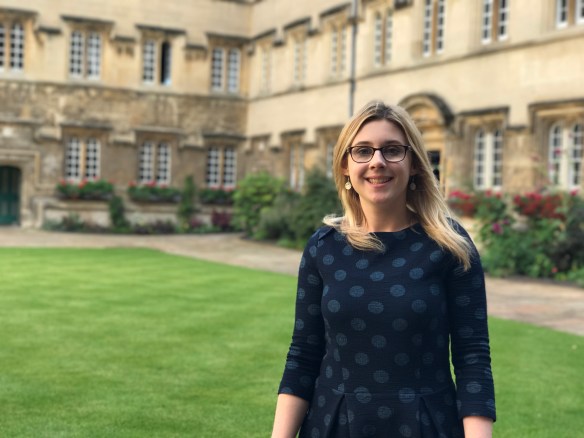
Dr Tomos Brodie from Jesus College Oxford

Darllenwch yn y Gymraeg

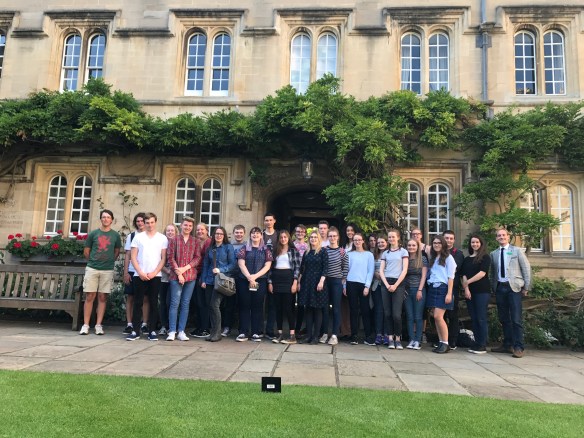
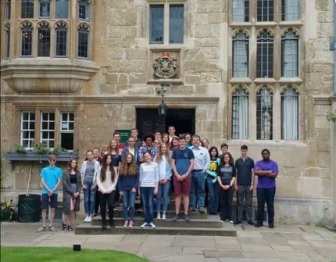
In August, 22 of our Seren students were given the opportunity to attend a free summer school at Jesus College Oxford. While we were there, we spoke to Dr Tomos Brodie, who teachers Modern German and European History at the university.

This is what he had to say about Oxford and why Welsh students should apply to study there:

Elin Roberts: My Seren summer school experience

Darllenwch yn y Gymraeg

This week’s blog post is from Seren student Elin Roberts on her experience at the exclusive Jesus College summer school in Oxford she recently attended.

Jesus College photos (1)

I remember as I arrived in Oxford on the train I began to walk briskly to the city, looking for Jesus College.  I was in awe with the picturesque city – it felt partly as a fairy tale land but it also felt as though I was walking through history.

I finally arrived at Jesus College. The large doors were a reminder of the doors of Hogwarts.

During the week I had the chance to have a taster of the Oxford life. I had the chance to taste everything from the academia to the city itself. I also had the opportunity to have a taste of different subjects within academia, subjects I had never thought of before. And more importantly I had a taste of Oxford’s unique teaching method by sampling numerous lectures, seminars and also having a tutorial.

The spectrum of lectures ranged from looking at exoplanets to the discussion of the future of global trade. I thought that this was fantastic because I was able to explore numerous subjects, most of which I never thought of before such as philosophical questions on the impact of technology and the potential existential risk. Another thing that I liked about this summer school was the fact that you could see the interdepartmental connections and as a results, could see how different departments collaborated together.  In the lecture on global trade it surprised me that global trade was worth $10m a minute but the poor countries only accounted for 0.4% of the industry.

Jesus College photos (2)

I personally thoroughly enjoyed the seminars because they allowed us to have a debate on various subjects. I really liked the fact that the seminars were primarily based on discussions that challenged us to think critically.  In the seminars we concentrated on different aspects of thinking critically.  I really enjoyed the seminar on #fakenews where we were read one story in three different newspapers. I found it interesting how a person’s political stance could affect the way a particular story was conveyed.

In another seminar we concentrated more on the use of statistics within documents and how they can be deceiving depending on the purpose of the specific document. I found this interesting because we looked at the prediction of the future economy. I have always been interested in politics but I have never really looked into economics and I am glad that I had the opportunity to do this at the Jesus College summer school.

As seminars were primarily discussions, I really enjoyed the tutorial because I was able to have a deep discussion on my essay but also discuss any other topics further. What I liked about this summer school was the fact that I had to write an essay, and learnt how to write it in the correct academic style. This skill will be useful in whatever I do – now during my A-levels but also within a career or at university.

As I walked around the college and the city I felt privileged that I was able to spend a few days at the historic university. I remember seeing the striking portrait of Queen Elizabeth I in the dining hall as we ate. Where else in the world could you eat while being surrounded by magnificent portraits?  I also enjoyed the opportunity to explore a little of Oxford. My favourite place was Blackwell’s Bookstore – the best bookstore in the world! It is a magical place where you’re surrounded by books. On the outside it seems rather small but in fact it’s like Narnia, with shelves and shelves of books.

If you do have the opportunity to attend a similar summer school I seriously suggest that you take the time to apply. The summer school has been one of my favourite weeks over the summer. Not only did I value the academic experience but I also valued the fact that I had the opportunity to meet some excellent people and create long lasting friendships. I would like to thank the Seren Network, Jesus College and Dr Matthew Williams for making this experience possible.

Julie Elliott: My first day at the Jesus College summer school

Darllenwch yn y Gymraeg

On this week’s blog, Cardiff hub coordinator Julie Elliott gives her thoughts on the first day of last week’s Jesus College summer school for Seren students.

Julie E

Like many of you, I was both excited and intrigued by the prospect of a summer school when it was launched at the national Seren conference in March. We were promised the prospect of a guaranteed two places per hub for our Seren to experience first-hand what Jesus College and the wider community of Oxford University has to offer.

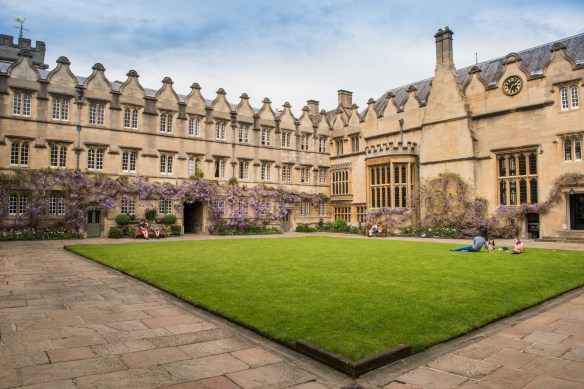
Of course, I had visited the city of Oxford before and had learned much about the university, I thought I knew what to expect. As I entered through the wide arch and crossed the cobbled stones I saw before me the immaculately coiffed, grassed quad, I couldn’t help but inhale sharply. I often joke with my students that despite a BA Ed and an MEd I am still scared of libraries and librarians. It is a symptom of the imposter syndrome many of us are prone to. Instead of the familiar fear of not being good enough, I was welcomed into the ancient seat of learning.

Some of the Seren students had begun to arrive, many were clearly nervous – this is the inaugural Seren summer school and despite meticulous planning, there was a feeling of pioneering in the air. All students have one thing in common, they all have the potential to gain a place to study at a prestigious university and be successful in any field they pursue.

Jesus College by John Cairns

Jesus College by John Cairns

Dr Matthew Williams is anything but a cliché of an Oxford professor – he is young and completely relatable to our 17 year olds.  He immediately put the students at ease, even admitting to some nerves himself!

No time for extended introductions, it was straight to the first of a series of lectures to unpick “Our Future: Humanity in a Hundred Years”, where we learned of table salt rain, sapphire snow flakes and the probability of life on other planets.

This was followed by lunch in the dining room, students were quickly gelling together, surrounded by portraits of former patrons of the college. The nerves had somehow dissipated and normality had taken over. A key aim of the Seren network – to bring together high achievers and use positive role models to break down misconceptions – was being achieved before our eyes. No student in this group would believe that they would not “fit in” at this or any other selective university.

Lunch over, introductions made, seeds of friendship and collaboration had been sown. The inaugural summer school was barely three hours old and already a huge success!

Making Successful Applications to University – Part 2: Enriching your application

Darllenwch yn y Gymraeg

In his last blog post, Rhys Phillips (originally from Blackwood), UK Student Recruitment & Outreach Officer at University of Southampton, looked at the process of choosing your course, and the research that should be employed to make an informed choice regarding your future degree.

In Part 2 of the post, he focuses on the second stage of making a successful application: enrichment.

southampton

Enriching your application

Obtaining a place at your preferred university can be a competitive ordeal, with the number of applications eclipsing spaces on many courses. For example, at the University of Southampton we received 42,405 applications in 2016, yet only made 5360 acceptances[1]. Therefore it is imperative to stand out from the crowd by creatively enhancing your application.

When making an application, you should look to positively engage with your chosen subject and find ways to demonstrate your interests to the admissions panel.

Read/ watch/ listen to the news – Remain ‘up-to-date’ with your chosen subject by demonstrating an awareness of how your subject is engaged with through the prism of the national media. For example, if you wish to study Medicine, Nursing or the health sciences, you could reflect upon how issues such as Brexit and NHS funding are impacting the role of healthcare professionals.

Work experience and volunteering – It is best to remember that any work experience is good work experience; even if you are consigned to making tea or photocopying, you still have the opportunity to observe professionals in your chosen field and gain a realistic impression of your future career.

Attending public lectures – Most universities will host some form of public lecture series throughout the academic year. These are often free and in some cases streamed live, making them a convenient opportunity to engage in the world of academia and to get a realistic feel for university teaching styles.

Online course material – Check the course page of your target institution for online course materials. Not all institutions will provide these, but some will post sample essays, reading lists and details of the syllabus. These are particularly useful for identifying the gaps in your own knowledge and providing the basis for some extra-curricular reading.

Reading around the subject – You may wish to engage with some academic subject material at this stage, and many academic textbooks and journals can be accessed through local libraries and online. However, you should also consider ‘lighter’ material to demonstrate your wider interests. Magazines such as National Geographic, New Scientist and BBC History Magazine have regular academic contributions, presented through a much more digestible medium.

Books2

Online courses and MOOC’s – A relatively new concept, Massive Open Online Courses (MOOC’s) provide an extremely convenient way to get a feel for learning at university level. Future Learn host hundreds of these courses, with many subject areas represented throughout the year. They are also free, and do vary in time and commitment, with the majority requiring 2-4hrs per week for a set number of weeks.

Extended Project (EPQ) – Ask your school or college if it offers the EPQ. If available, the EPQ gives you the opportunity to develop both your independent research and critical thinking skills, and should facilitate a much smoother transition between Further and Higher Education.

Once you have suitably enriched your application, you should now think about how this material would fit into your personal statement. It’s important to not simply list all the activities undertaken, as this will likely result in the admissions staff developing a ‘so what?’ attitude to your application. Instead, consider the transferable skills that you can demonstrate through your experience and how they have improved you as a potential candidate. Below is a list of transferable skills and some suggestions as to how they might be demonstrated through the enrichment activities:

Referencing: EPQ, MOOC

Research: EPQ, MOOC, online course materials, news, reading around the subject

Time management: Work experience and volunteering, EPQ

Critical thinking: EPQ, MOOC, public lectures, reading around the subject, news, current studies

Communication: Work experience and volunteering

Teamwork: Work experience and volunteering

Presenting: Work experience and volunteering, EPQ, public lectures

Independent thinking: EPQ, MOOC, reading around the subject, news, current studies

In the next and final post of the series, we will focus on drafting the personal statement.

[1] https://www.ucas.com/corporate/data-and-analysis/ucas-undergraduate-releases/ucas-undergraduate-end-cycle-data-resources/applicants-and-acceptances-universities-and-colleges-%E2%80%94-2016


A look ahead to next week’s Seren summer school at Jesus College

Darllenwch yn y Gymraeg

Next week, 22 lucky Seren students from the 11 hubs across Wales will spend four days at Jesus College Oxford in a tailored summer school programme to help give them a taster of university life.

Jesus College by John Cairns

Jesus College by John Cairns

The free summer school is exclusive to Seren students, and will focus on the theme of ‘Humanity in 100 years’, with lectures, seminars and debate sessions hosted by Oxford University professors. The aim of the sessions is to perfect the students’ writing, speaking and reasoning skills – as well as offer the chance to find out what it’s like to attend a top university, staying together in college halls and exploring the city to get the full Oxford experience.

Study topics will include a range of areas focusing on the future of humanity, from international trade and political communications to climatology and artificial intelligence, as well as a trip to the Museum of the History of Science in Oxford.

It’s not just about the lectures though – students will have free time to explore the picturesque campus and will dine in the historic Jesus College hall.

The students who have been awarded a place at the summer school are:

  • Annabelle Tamsin Blight
  • Ben Griffiths
  • Caitlin Hannah Duggan
  • Charlie Cromwell-Pinder
  • Charlie Greenall
  • Elin Roberts
  • Ellie Jones
  • Emyr Al-Rawazik
  • Ffion Wyn Jones
  • Gwyn Donlan
  • Heledd Roberts
  • Luc Irfon Pryer-Smith
  • Lucas Watts
  • Lucy Campbell
  • Marcus Emery
  • Miles Hermann
  • Natasha Gargan
  • Nye Michael
  • Owen Kelly
  • Rachel Ellen Brenton
  • Rebecca Lauren Jones
  • William Fellows

We’ll be updating you on all the news and events from the summer school next week across our social media channels, so stay up to date by following us on our Facebook page, on Twitter @Seren_Network, or here on the blog.

Carmarthenshire and Pembrokeshire Hub Trip to Oxford

Darllenwch yn y Gymraeg

This week, Ffion Wyn Jones from Ysgol Dyffryn Taf tells us about her hub trip to Oxford.

Oxford visit1a

I remember being ecstatic when I received the email confirming that I had been nominated by my head of sixth form to attend a three-day residential at the University of Oxford in July 2017. However, once the initial excitement wore off I began to feel a little nervous. “I’m not some insanely clever super genius!”, I thought, “will I feel awkward and out of place?”. Despite the Seren Network’s best attempts to dispel the idea that Oxford is only accessible to those who have 27 A*s and are taking 7 or 8 A levels I couldn’t shake the idea that I wouldn’t be ‘good enough’ for Oxbridge. I also had my own notions that Oxford would be full of public school educated Bullingdon members. However, over those three days those misconceptions were torn to pieces.

From the moment I stepped onto the coach I enjoyed being surrounded by likeminded students from all over the Carmarthenshire and Pembrokeshire hub and the trip just got better and better from there. Everyone at all of the colleges we visited was friendly and welcoming and they seemed very happy to show us around and tell us all about their colleges. The sample lectures we attended were a fantastic introduction to how students are taught at Oxford. They were also incredibly informative and engaging. One of the lectures from the Physics department was on superconductors, I want to study English Literature and I honestly thought I would be a little bored, but it was fascinating! The other lecture, on language in politics, totally blew my mind! It was essentially an hour of discussing why and how words have the power to be weapons and it made me consider concepts I had never even thought about.

Oxford visit2

We were also taken through the major parts of the Oxford applications process. It was confirmed that what Oxford really wants is students who are passionate about their subject and who can demonstrate academic ability and potential. We took a short sample Thinking Skills Assessment (which wasn’t nearly as terrifying as I anticipated!). Although the TSA is not used for all subjects, it was useful for all of us as many subjects use similar admissions tests. We were informed that the hardest aspect of these tests is the timing; and that the best way of preparing ourselves is to familiarise ourselves with the tests by practicing the past papers available online.

In addition, we attended workshops on personal statement writing and interview preparation. It was again reiterated that the most important thing was that we showed motivation, enthusiasm and a genuine love for our chosen subjects. We practiced writing the first sentence of our personal statements (a surprisingly difficult task!) and we all received specific feedback on how they could be improved or how we could continue our statements. There was also time for us to enjoy the beautiful surroundings and visit colleges.

I would personally like to thank Jon Jones for organising the trip, Maxine Thomas and Cheryle Barker for supporting us throughout the trip and Dr Matthew Williams for being so helpful, welcoming and providing invaluable information. I am incredibly grateful for this awesome opportunity and for everything else the Seren Network has done to aid me in applying to university.

Emily Kemp: Advice I wish I had been given as a prospective English student

Darllenwch yn y Gymraeg

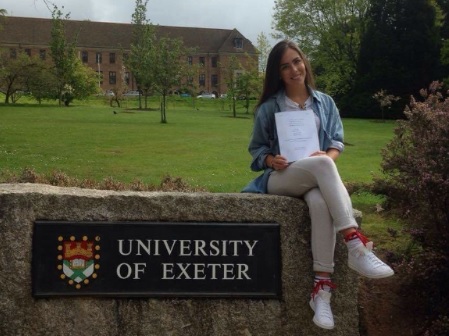
Having just completed a three-year undergraduate course at Exeter University, here is the advice Emily Kemp wishes she had been given as a prospective English student.

 Emily Kemp2

  1. Absorb knowledge in whatever form it comes in. At university expect a far broader definition of what constitutes ‘good’ literature than in GCSE or A Level. Your inspiration can come from music and television as much as books and poetry; everything is valid and worthy of discussion. So beyond the syllabus read, watch and listen to anything that genuinely piques a creative interest; I have read essays on British grime culture that are as eloquent and intelligent as those on Dante and Shakespeare.
  2. Do not hold onto what you were taught at A-level. You will find that the exact formulas for writing A-A* essays at A-level will not be of much use when producing work to a university standard. I found that whilst I had a natural writing ability, it was not until the second year that I truly developed the discipline and structure vital in writing good academic essays. Starting off with low 2:1’s and some 2:2’s, I was delighted to be awarded a 1st by the end of my degree – the most important element of my results was that they demonstrated an upward trajectory. I would suggest that everyone approaches first year as a chance to develop your skills and explore your creativity in more exciting and original ways than secondary school allowed; don’t get preoccupied by grades immediately.
  3. Be brave with your module choices. In my first year I picked a module on Shakespeare adaptations over a module on film 1950’s – present, because I thought I should study Shakespeare and that modern film somehow wasn’t ‘highbrow’ enough. It’s a choice I regretted and tried to correct with my choice of topics in the second and third year. I have a passion for literature that is produced by and for modern cultures, and my final year was spent completely consumed by my reading of 20th and 21st century literature from ex-British colonies. This was work often written by minority groups that would not have featured on any academic syllabus a few decades ago. I would urge no one to waste this opportunity, and to go wherever your interests take you.

OLYMPUS DIGITAL CAMERA

 More general advice for prospective students:

  1. Visit the university you plan to attend. It sounds obvious, but no photograph or website can completely convey the campus environment. I would strongly recommend a visit to your choice of university whilst term is still in session; pay attention not only to the facilities but to the current students – is the overall atmosphere a positive one, and one you can see yourself fitting into?
  2. Have patience with yourself and your new surroundings – it will take time to feel at home. There is immense pressure to immediately enjoy university – after constantly being promised it would be ‘the best years of your life’, I overlooked the fact that the first few months at university can be really hard. Living away from home for the first time, making new friends, getting used to your course; it is a huge learning curve and one that takes time to adapt to.
  3. Join societies that interest you. On the whole you will find that university is a really accepting and inclusive space – however normal or unique your interests are, there will be groups and teams to cater to them. In the first few weeks there will be lots of society socials and recruiting events; don’t be scared to go to these by yourself, as they are designed to introduce like-minded people to one another and are a fantastic place to make new friends outside of your course and halls. I have definitely had a more rounded and enjoyable experience – from debating events to nights out and trips abroad – by being a member of university societies.

How you could make your UCAS application stand out with an Open University course

Darllenwch yn y Gymraeg

This week, The Open University tells us how you can make sure your university application stands out from the rest by studying one of their courses.

Open University

Although this academic year is almost over and your mind is already on the summer holidays, next September will come around faster than you think, and those of you in year 12 and year 13 will be thinking about your university applications.

With so many students competing for places at the top universities, it’s important to think of ways to make your application stand out from the rest.

One way to do this is to take advantage of a new programme introduced by The Open University for Seren students in Wales.

Studying an Open University module alongside AS and A2 courses can help you in several ways, including:

  • Achieving greater exam success
  • Evidencing your strengths and aptitude on UCAS applications
  • Standing out when competing for a place on a competitive university course by studying a degree level course alongside your A Level study

There are a range of courses available across a variety of subject areas, from languages and social sciences, to science, mathematics, and business and management.

Studying with the OU is very different from school or a traditional campus university; the courses are online and you study in your free time when it suits you, so you have the flexibility to prioritise your AS and A level studies.

OU2

If you’re worried it’s going to be too difficult, don’t be! Yes, the module will challenge you, but we’ve selected some of our level one modules that are short and have built in support for you.  We call this Supported Open Learning, making sure that you have the help you need to learn in the best possible way.  You get regular support from our tutors and access to all the learning materials and resources essential to your course.

What’s more, as a Seren student you may be able to study an OU module for free with Welsh Government bursary funding, which will cover the cost of the Open University module fees.

The Seren coordinator in your school can help you find out more, plus you can have a look at our website www.open.ac.uk/wales/seren for a full list of courses starting this October and details of how to apply.

If you can’t wait until October, why not have a look at some of the OU’s free courses, interactives, videos and more on our free Openlearn website

Women in Physics: A Worthwhile Battle

Darllenwch yn y Gymraeg

In this week’s blog, RCT/Merthyr hub student Beth Lisles talks about women in physics, and why women shouldn’t be afraid of pushing themselves to succeed in a field still dominated by men.

HJ-Seren-Holybush-0801.jpg

If you Google “Women in Physics” the first few hits you get are about the WOP societies at various universities or lists of notable women in the field. However, go down to about the seventh suggestion you get an article entitled “Women in Physics face Big Hurdles – Still”, it takes a critical look at the numbers surrounding the deficit in uptake and continued study of physics and partially apportions it to the lack of female role models in the physical sciences.

This is something that I have observed in my own physics education. I was one of four ladies who started Physics AS and this shrunk by half before the AS exams while the other was accepted into Yale (in the USA) to study Mathematics. This may well have been down to a lack of fellowship and due to the changing nature of their physics education, or the undermined confidence in their abilities. It can happen all too often with young women in physics that they feel their core maths skills aren’t as strong as they should be; this continues into higher education with a proportion of students not undertaking degrees or post-graduate qualifications in physics when their results would prove that they are more than capable.

But is there any real reason for this other than lack of confidence? I don’t think so. Academia has seen the negative effects of its biases, where benefiting from a mostly male viewpoint leads to exclusion of female ideas. As such, positive biases have been instituted to counteract this effect. These include the numerous WOP societies and unions at universities and across the world, as well as the many scholarships offered to undergraduate and post-graduate women. Having applied to the King’s College London Women in Science Scholarship and in researching for this post, finding the Roche University Bursary then drastically trying to complete the application before 5pm, I realised that help is available for us ladies in science if we only look for it. However, it is a bit hidden away.

This made me think again about the role models in our community – the hidden ones and those that are more well known. So, here’s a little list of our lovely lady scientists and their accomplishments:

  • Hypatia – Roman Egyptian, studied and taught mathematics, astronomy and philosophy while there were very few women in science (ca. AD 350/370 – March 415).
  • Maria Goeppert Mayer – Nobel Prize in Physics 1963 for “discoveries concerning nuclear shell structure” (with E. P. Wigner and J. Hans D. Jensen).
  • Marie Curie nee Sklodowska – Nobel Prise in Physics 1903 (with husband Pierre and Henri Becquerel) “in recognition of the extraordinary services they have rendered by their joint researches on the radiation phenomena discovered by Professor Henri Becquerel”. Followed by the 1911 Prize (for Chemistry), shared with Pierre, for their discovery of radium and polonium.
  • Mary Somerville – studied maths and astronomy against the wishes of her father and was the second female scientist to gain recognition in the UK (1780 – 1872).
  • Lise Meitner – a nuclear physicist and part of the team that discovered nuclear fission but was passed over for the Nobel Prize which was awarded only to her male colleague (1878 – 1968).
  • Ada Yonath – the first female Israeli to win a Nobel Prize for her research into ribosomal structure and function using crystallography.
  • Mae Jemison – the first African American woman in outer space and founder of a technology company focusing on applications of technology in everyday life.

In these cases, the women have often had to overcome situations imposed on them by a patriarchal society and break free of the biases placed upon them. If they can do it, so can we. There are role models out there. So ladies, if you need a boost and you’re feeling down about your abilities, skills and prospects take a look at some of these amazing women and use them as inspiration to see just how far you could go.